

Samsung Galaxy Book 2 tablet review: Performance takes a back seat to battery life - hamiltonsexpround

Mark Hachman / IDG
At a Glance
Expert's Rating
Pros
- Absolutely the best battery life we've seen, period
- Ray-engineered tablet build is on a par with competition
- $999 cost tag is very competitive, and includes keyboard and pen
- Optional LTE gives you connectivity on the go
Cons
- Low overall performance
- Included apps aren't really indispensable
- Is this app exit to work? There's always whatsoever uncertainty
Our Verdict
Samsung's latest 2-in-1 now looks much like the competition, but with a key change: it uses Qualcomm's latest Snapdragon processor, which delivers spunky-dynamical battery life but anemic performance.
High-grade Prices Today

$999
Ease up Samsung credit: the Galaxy Book 2 boldly breaks from the original-propagation Galaxy Book on both the inside and outside. The company's new 2-in-1 non only ditches its flimsy folding keyboard in favou of a more longstanding tablet kickstand, but also joins the small ranks of PCs that sustain adoptive a battery-sipping Qualcomm Snapdragon microprocessor. Performance suffers drastically, however, eve as battery life story soars to an unexampled 18 hours.
The Wandflower Book 2 boasts Samsung's terrific AMOLED displays and privileged sound, with LTE capableness, a pen and a keyboard, all sold for a moderate $999.Remove non-product linkIn addition to the CPU switch, though, the second gear generation makes some compromises. The built-in 4GB of memory and 128GB of reposition is a bit skimpy, for instance, and the OS—Windows 10 Home in S Mode—might turn some off. For basic turn on the road, the Galaxy Book 2 offers some compelling arguments. But the experience is tranquil too bumpy to recommend to everyone.
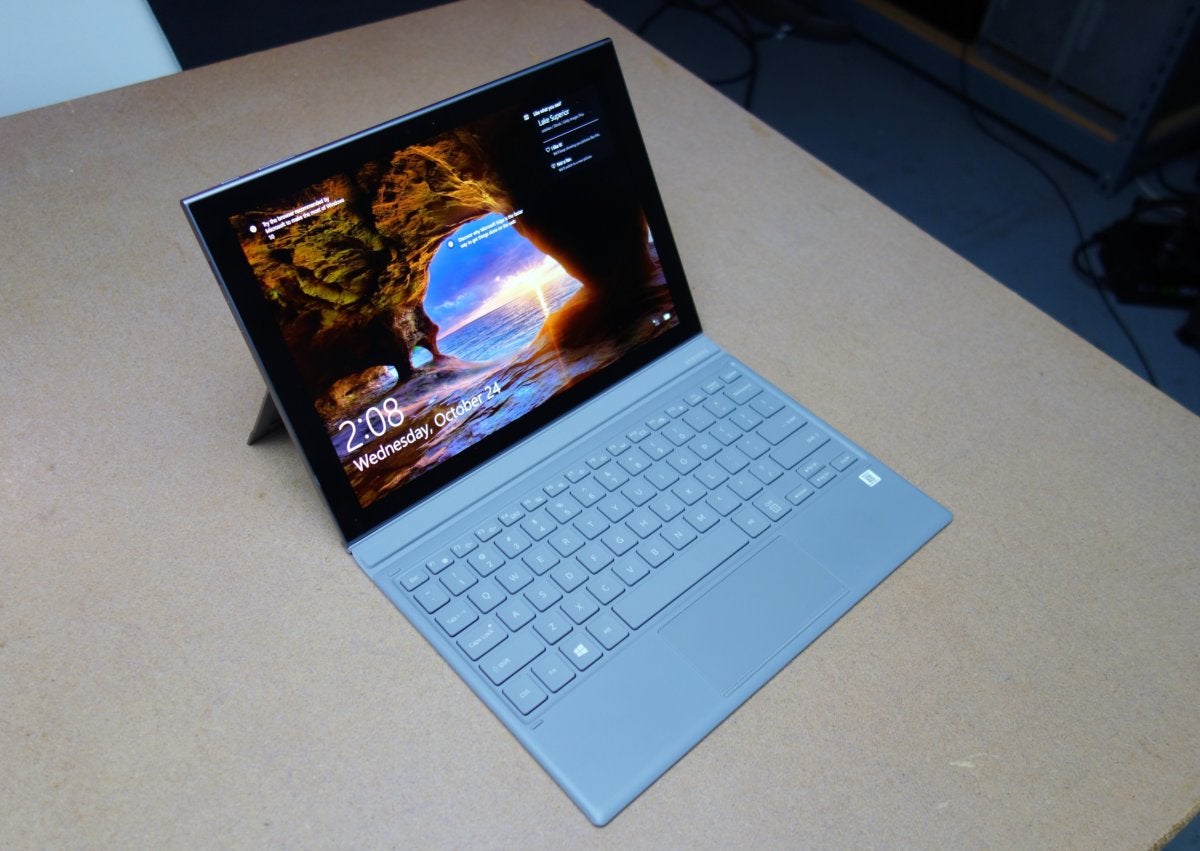 Mark Hachman / IDG
 The Galaxy Book 2 uses a Surface-style fold flexible joint. (Here, it's unfolded to show the keyboard better.)
Galaxy Book 2: Basic glasses
- Display: 12.0-edge Samsung AMOLED (2160×1440)
- Processor:Qualcomm 8-core Snapdragon 850 (4 cores @ 2.96GHz; 4 cores @ 1.7 GHz)
- Graphics: Qualcomm Adreno 630 (integrated)
- Memory: 4GB
- Storage: 128GB SSD
- Ports: 2 USB-C, microSD, headphone jack up
- Wireless: 802.11 a/b/g/n/ac VHT80 MIMO; Snapdragon X20 LTE Modem
- Cameras: 5MP front, 8MP rear
- Battery: 47Wh
- Operating scheme: Windows 10 Home in S Fashion (Windows 10 Home every bit proved)
- Dimensions: 11.32 x 7.89 x 0.30 inches
- Weights: 1.74 pounds (tablet), 2.42 pounds (tablet nonnegative keyboard), 2.64 pounds (pad of paper, keyboard and charger), as measured
- Price: $999Remove non-cartesian product link; S Pen and keyboard included
Galaxy Book 2: Chassis quality and ports
 Mark Hachman / IDG
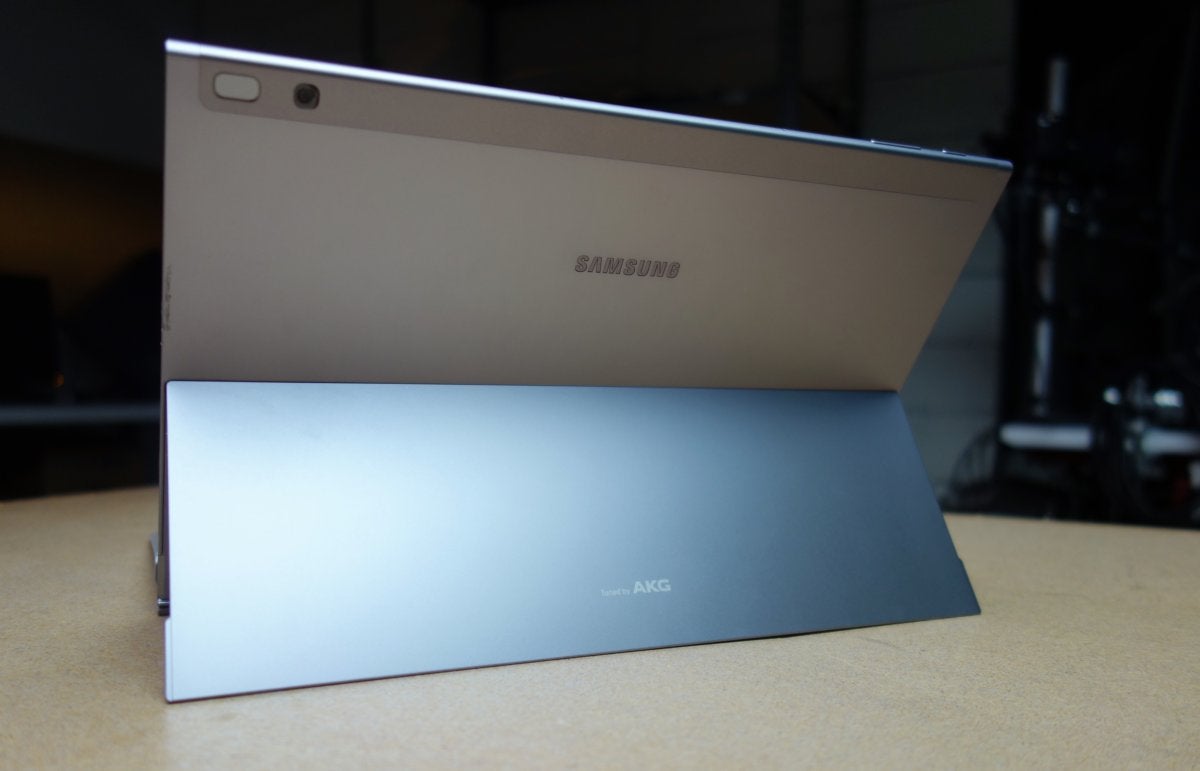
 The Samsung Galaxy Record book 2, tuned past AKG.
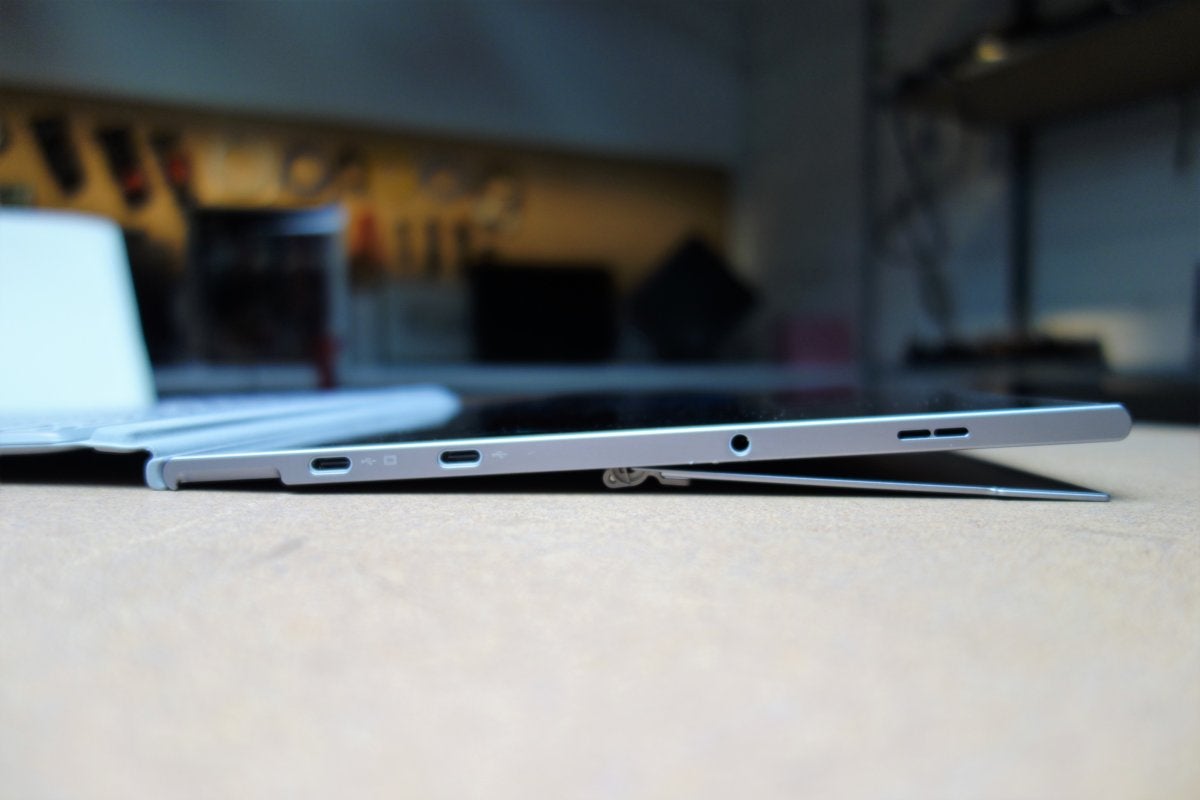
Physically, the Galaxy Book demonstrates that changing horses midstream sometimes necessitates a new harness and tack. The Galaxy Bible 2 is a tad shorter, a bit wider, slightly thicker, and 0.08 pounds lighter than its predecessor. More importantly, it's now built like-minded a traditional tablet, with a kickstand that nearly fully reclines, like a Microsoft Surface Pro 6. Adios, folding keyboard.
The first-generation Book sported a chunky bezel surrounding the sort, and I was hoping for something a bit leaner this time more or less. Nary destiny. Fortunately, if you've seen a Samsung display before, you know what you get: deep, dark blacks and lush colors—though maybe not as rich or colourise-correct atomic number 3 the displays on Microsoft's Surface Pro 6. The AMOLED touch screen video display pumps out a comfortable 329 nits of luminance, which will work well indoors and out. Piece the tablet isn't totally sealed—few vents on either side seem like some sorting of new, strange expansion port—IT is fanless.
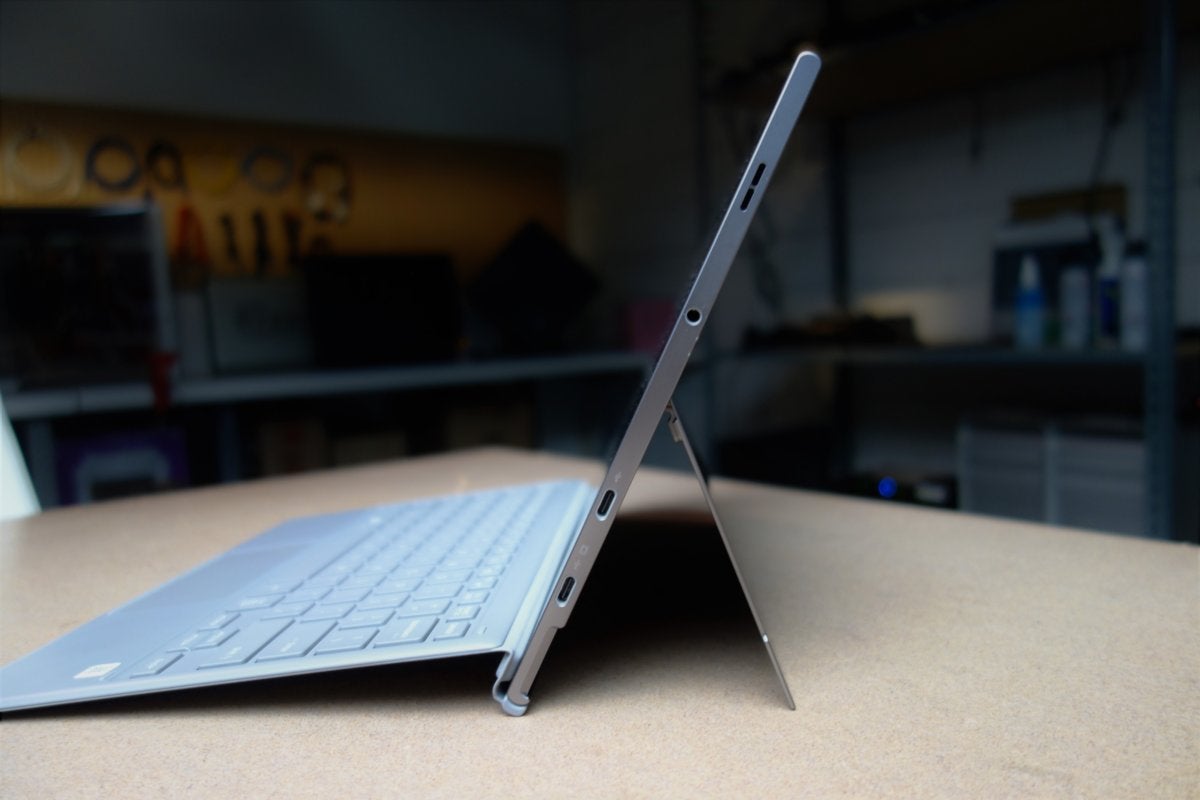
As for factual expansion ports, Samsung leapt ahead to USB-C with the first Galaxy Book, and the second Galaxy Book 2 also sports a pair of USB-C ports. Unfortunately, Samsung wasn't American Samoa thoughtful arsenic, say, the Huawei Matebook: You'll have to issue your own USB-A adapter if you want to tie in to legacy devices. Fast Thunderbolt connections aren't available, either.
 Mark Hachman / IDG
 Deuce USB-C ports provide the primary form of I/O capability…
Keep in mind that the LTE time slot as wel doubles as a microSD holder, though adding or subtracting either a SIM surgery microSD posting requires one of those annoying smartphone poky SIM tools to slide the draftsman out.
 Mark Hachman / IDG
 …just as the Galax Book 2 fully reclines.
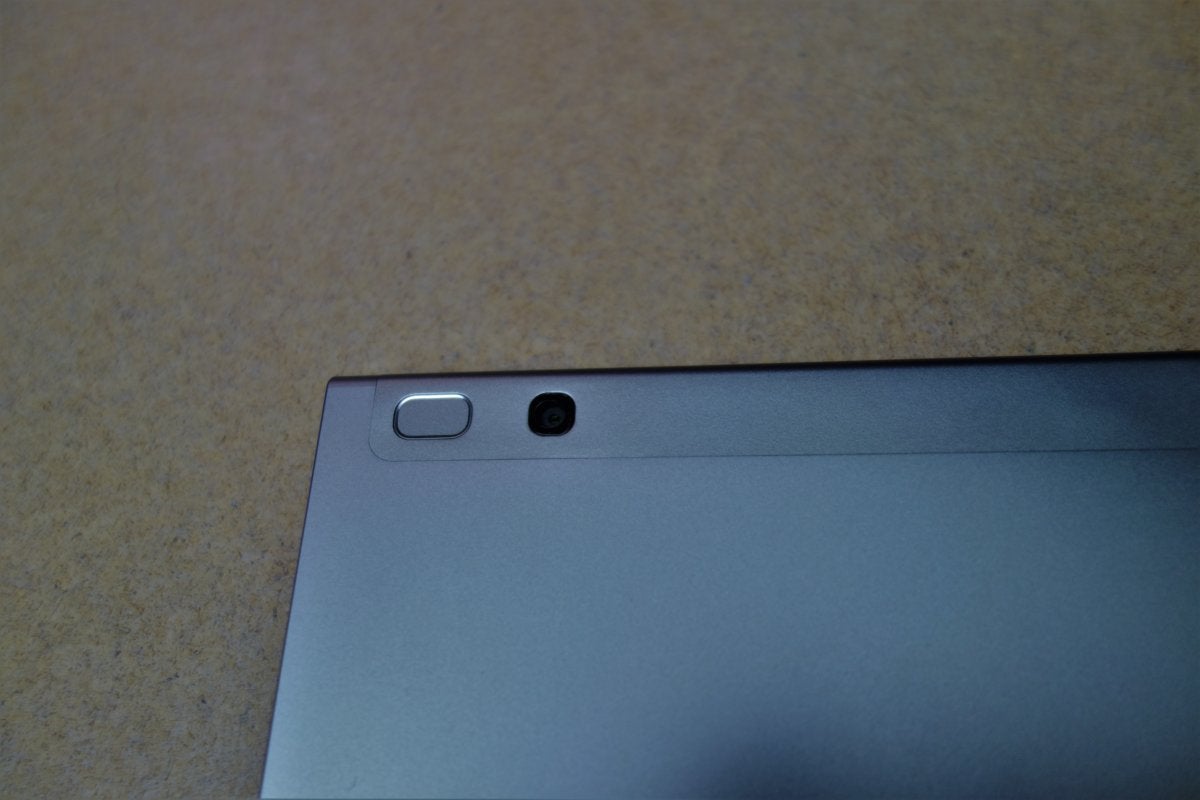
There's no Windows Hello-certified depth camera, though there's a fingerprint lecturer on the rear of the tablet, properly next to the camera. IT seemed to have some problems reading my digit during setup, and I'm not sure of the advisability of placing a fingerprint sensor next to a camera lens system, which could be easy smudged. Otherwise, though, it whole kit and caboodle acceptably.
 Mark Hachman / IDG
 Victimisation the fingerprint reader requires reaching round blindly to swipe your finger.
As for LTE, information technology's clearly same of the reasons for buying a device like the Galaxy Book 2. If you want to be forever connected (and WHO doesn't?) a tablet like this will practice the trick. A Verizon SIM was provided for brushup. I don't feature a Verizon-powered smartphone for comparing reception, but the Book 2 seemed to cull up a signal everywhere a T-Mobile earpiece could, and so some. Commemorate that you'll be competent to buy a Galaxy Book 2 from a Sprint, AT&T, or Verizon store, only you'll have to pay extra for a connection plan.
As noted elsewhere, though, Windows prioritized the LTE connection over my Badger State-Fi connection. That's a problem for two reasons: First gear, not totally cellular plans are unlimited; and a cellular connection was (fortunately) listed atomic number 3 "metered" by Windows. While that prevents multi-gigabyte updates from being downloaded, unnoticed, over your cellular association, information technology also agency that updates and OneDrive syncing stool't take place without manual approval.
Finally, don't leave that the Samsung Galaxy Playscript 2 ships with Windows 10 in S Mode, which restricts apps to what's provided in the Microsoft Store. Do you prefer Google's Chrome browser? No-account! Commemorate, switching from S Mode to the full-fledged Windows 10 Home is a pretty simple experience, and shouldn't be you anything. It's a one-way switch, though.
The real problem is that we silent ran into applications—specifically two of our benchmark applications—that unconditionally refused to keep going our Galaxy Book of account 2, because of the way they were coded. That's a risk you'll have to take.
What about that keyboard? Hold reading to find out.
Galaxy Al-Qur'an 2 typing undergo
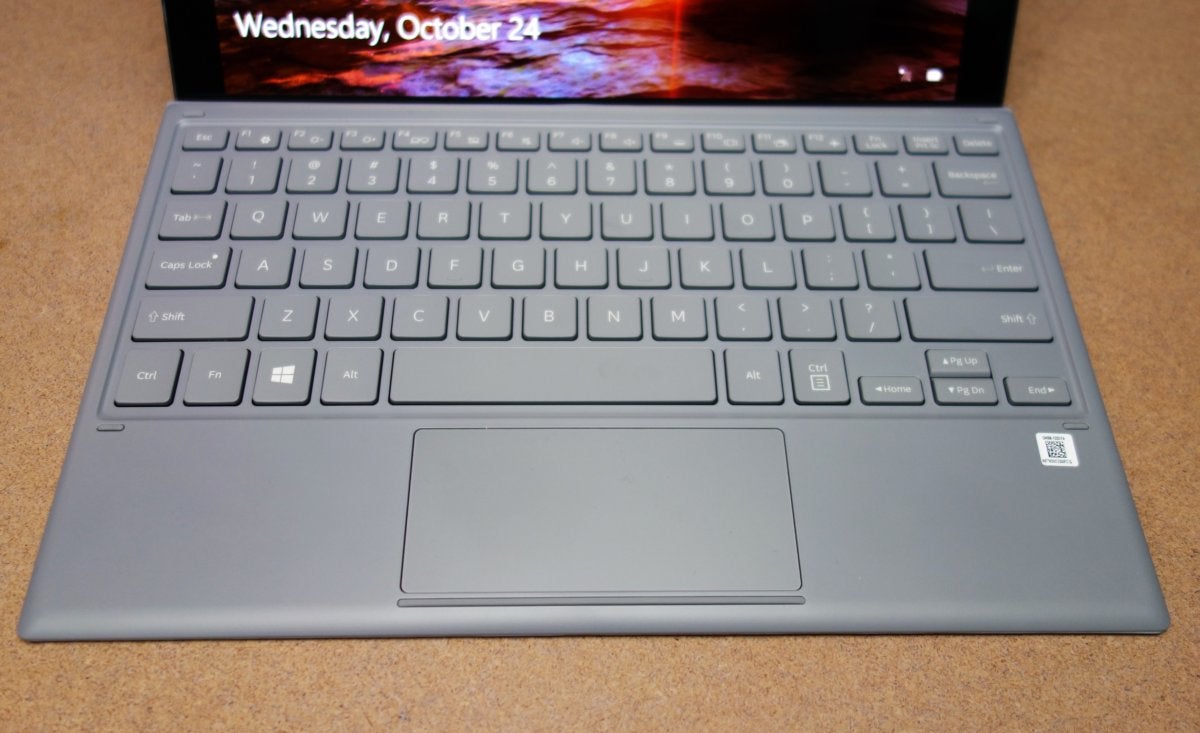
Typing on the Galaxy Book 2's bundled keyboard is amazingly decent. Apiece winder offers a kinda spacious landing bolster for your fingers, with admirable key travel and resiliency. (I wouldn't embody surprised if the keyboard were bu a holdover from the for the first time-genesis Beetleweed Book.) The keyboard does flex well, though the movement felt Sir Thomas More akin to the springiness of an athletic shoe rather than the sag of an old bed.The trackpad is mediocre, nonetheless, and it feels small and somewhat unresponsive.
 Mark Hachman / IDG
 The Samsung Galaxy Book's keyboard is surprisingly comfy, and the trackpad is serviceable.
Samsung has adopted the now-traditional double-foldable hinge, which connects the keyboard to the tablet. As someone who prefers a slimly angled keyboard, the ease with which the keyboard unhinges is annoying —there's even a hidden Samsung label that makes me think the behavior's intentional. But the final attraction connection holding the keyboard in situ is pretty close to rock-solid, leading Maine to believe that you could work with it on your lap for prolonged lengths of metre. The hinged kickstand reclinesway backward, almost but non quite monotonic.
I'm affected with the Galaxy Book 2's speakers. Given, because of the physical limitations of a tablet, they can't really deliver even the low-end oomph of a connected speaker like the Harman/Kardon Invoke. Only even without any augmentation, the range of sound the Book 2's speakers redeem is relatively balanced, with good volume. They improve even further with the included Dolby Atmos augmentation—which, somewhat surprisingly, ships off by default and needs to be enabled with an app. With Dolby Atmos enabled, the Christian Bible 2 delivers a fairly rich soundscape, from highs to lows.
Galax Book 2 apps: A motley suitcase
The Galaxy Book 2 offers an acceptable measure of storage (128GB), though anything below 256GB triggers a second of paranoia that I'll run out of room. How Windows 10 integrates OneDrive assuages that somewhat, as you buns clog files to the cloud and let them remain arsenic "placeholders" on the drive. (For roughly reason, however, the Book 2 wanted to default to the Verizon LTE SIM that Samsung enclosed—which was plant up as a metered connection, andthat means OneDrive South Korean won't automatically sync your files to the dapple. I had to disable the cellular connection manually to convince Windows to use my unmetered Wi-Fi and ethernet.)
Connectivity issues aside, however, the fact remains that the Galaxy Christian Bible 2 ships with the usual full complement of bloatware (Confect Press, Candy Crush Soda as Saga, Disney Wizardly Kingdoms, etc.), which you'll want to delete straightaway. There's likewise the constitutional Samsung apps, which we discussed in more detail under the "Bundled apps" incision of our original Galax Book review. These are more pardonable, especially the Extragalactic nebula Book app that ships with some minimal configuration options, such As adjusting the show color affectionateness or preventing the Galaxy Reserve 2 from charging more 85 percentage to maintain the longevity of the battery.
 Mark Hachman / IDG
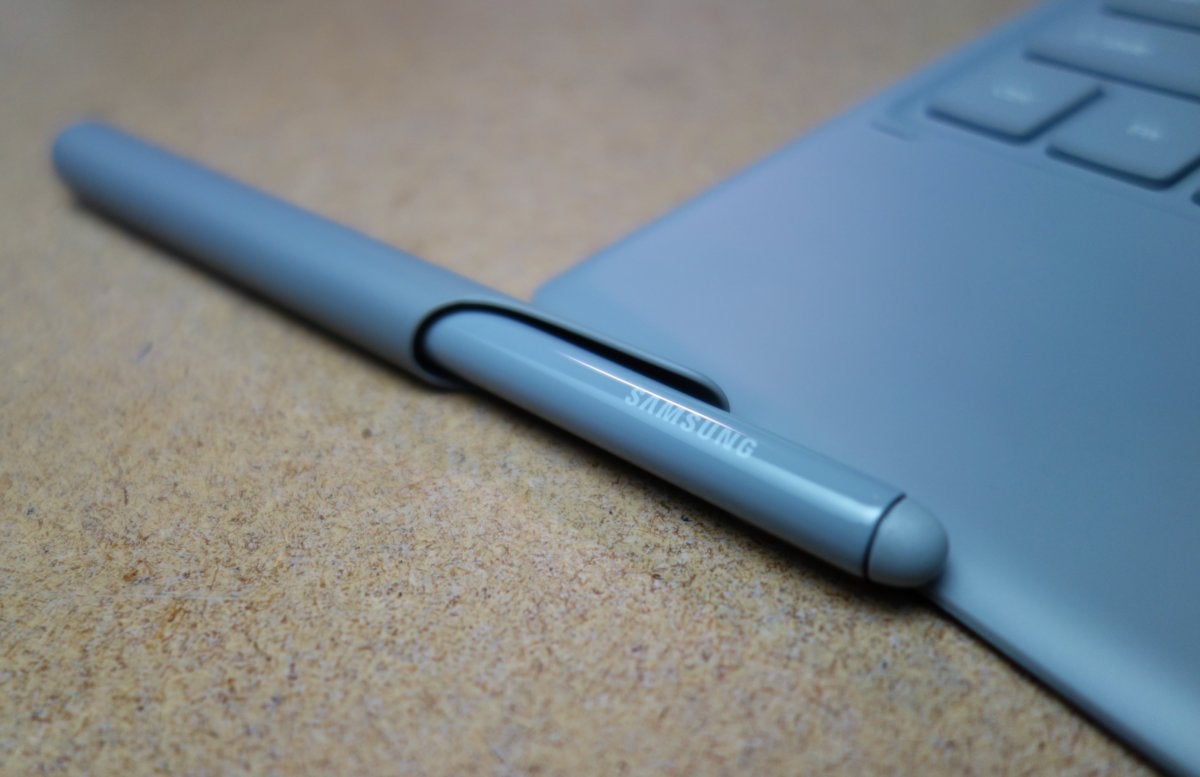
 Samsung's pen slips inside this large plastic holder, which apparently just roams free inside your bag.
Samsung shipped the Galax urceolata Book 2 with Samsung Flow, which works to unlock your PC victimisation your phone—something that Windows Hello should make redundant? Samsung Gallery also works passably like the Your Phone app within Windows: Originally organized as a conduit to overtake photos affected with a Galaxy phone to your Galaxy Book 2, it now can use a more generic Bluetooth connection via a Google Play app that can be downloaded by any miscible Humanoid phone.
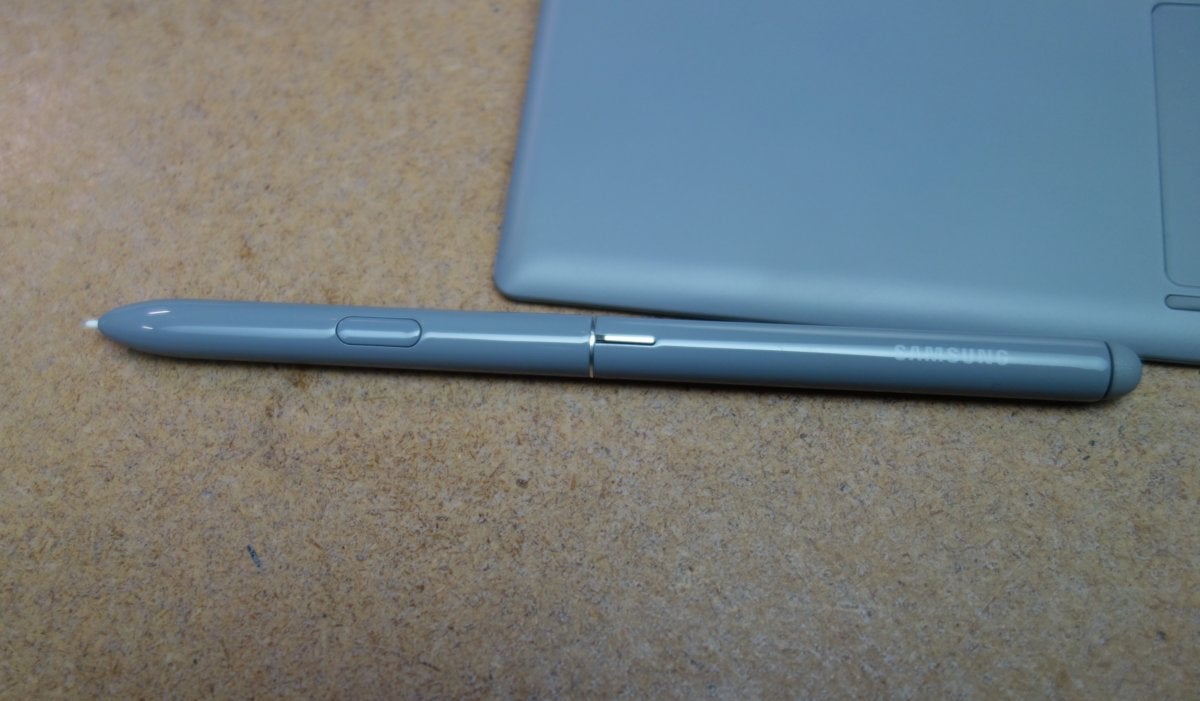
The prototypic Galaxy Book shipped with an S-Pen, bundled as a discrete accessory. I criticized the want of integration. The many recent Samsung Notebook computer 9 Pen adopted the built-in pen holster used by the Galaxy Note phones and tablets, which I mirthfully applauded until I unexpectedly jammed the S-Penitentiary nonfunctional-way in. The Wandflower Book 2 uses an odd sleeve apparently Re-purposed from a meat thermometer… and, well, given my past history, I'm okay with that. It power have been nicer with an accent people of color, operating theatre perhaps a clip of some sort, but Samsung's Brutalist design should diaphragm absent-minded reviewers from stuffing the S-Indite where it shouldn't go.
 Mark Hachman / IDG
 Hera's the pen, out of its case.
What about benchmarks? Keep reading to find out.
Galaxy Book 2: Cross-platform benchmarks
Samsung's choice to move back from an Intel Core i5 CPU to a mobile chip shifts the emphasis from performance—where the first Galaxy Book did selfsame well—to battery life. It's our first prove of the new, next-gen Qualcomm Snapdragon 850, which promises "multi-day" stamp battery life as well as more speed.
Does the new Snapdragon 850 have enough oomph for you to be happy? Well, it depends. Ascribable the anemic central processing unit and low system memory, web browsing is broadly speaking acceptable with limited tabs. Bureau process, like word processing, is impartial fine. YouTube videos are child's play—there's a special video decode engine in the Adreno graphics chip, and a 1080p video consumed about a third of its resources. Games? Don't estimate it, especially anything really modern.
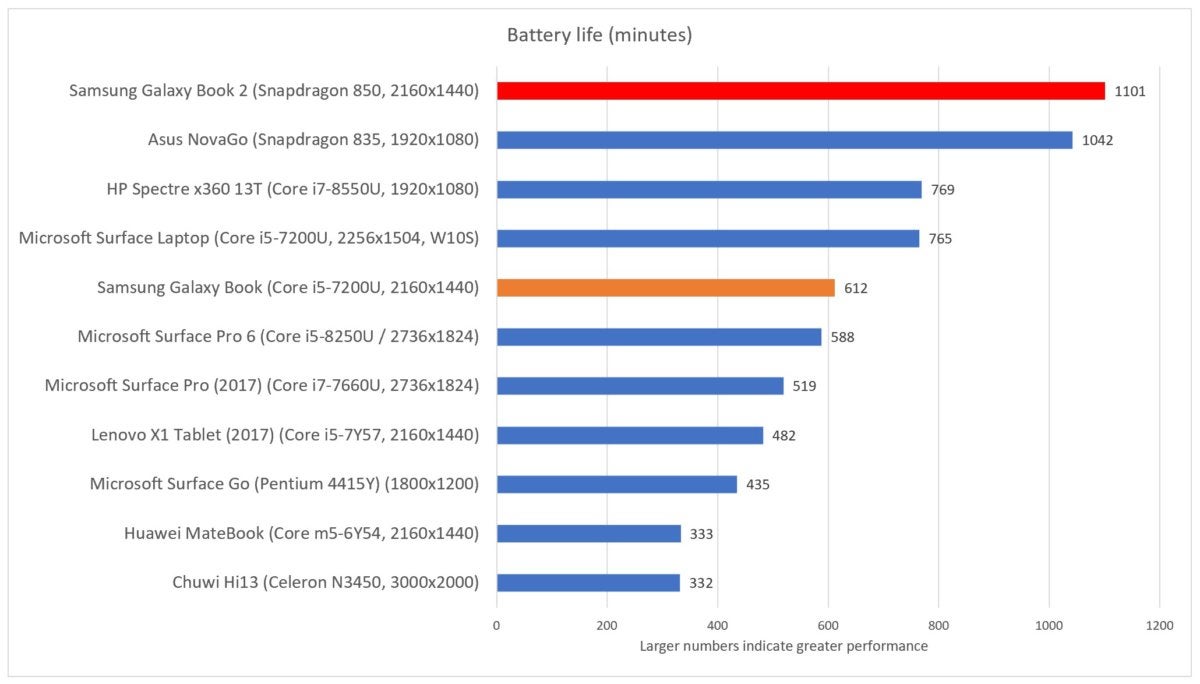
What our tests indicate yet is that the $999 Galaxy Book 2's performance is in the neighborhood of the $399 Microsoft Surface Go, which is a "good-enough" small-form-factor tablet in its own right. Remember, too, that the Book 2's battery life pretty much blows everything else away—information technology's over doubly that of the Surface Survive's!
One caveat: Samsung says it volition ship its new Galaxy Volume 2 with Windows 10 Home in S Mode, but it inexplicably shipped ours with Windows 10 Home enabled—which we noticed subsequently operative several of the browser-based tests we'd normally function for testing a Windows 10 S Personal computer. Information technology's possible that running Windows 10 Home rather than Windows 10 Home in S Mode whitethorn invalidate these results—S Mode is supposedly a more optimized environment, but it doesn't permit for any apps outside of the Microsoft Store. But they look consistent with our more traditional benchmarks.
Because these are browser-based benchmarks, we can compare the Book 2 to non-Windows devices, "first"-generation Snapdragon-powered PCs like the Asus NovaGo, and even Orchard apple tree devices and an Android tablet. Note that though we didn't have an opportunity to run our overflowing cortege of benchmarks for our original hands-on, we ready-made sure we ran them all for this, our review. We were pretty sure that our initial tests would Be indicative of final execution, simply we were slightly mistaken—barrage fire life actually increased. These tests reflect those numbers racket.
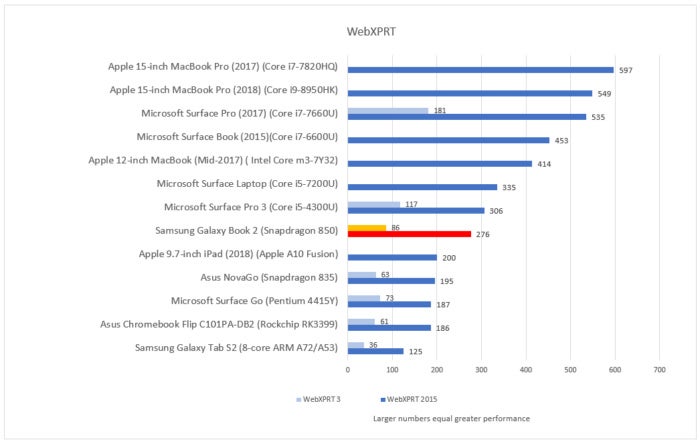
First up: WebXPRT, a not bad all-around benchmark which uses HTML5 and JavaScript to mimic traditional web apps. We have a broader database using the older 2015 benchmark, and few entries tested victimization the more WebXPRT 3 update. The Galaxy Book lands in the lower middle of the pack.
 Mark Hachman / IDG
 Samsung's Galaxy Bible 2 finishes in the middle of the pile of these devices, though these generally lean toward senior PCs and Macs.
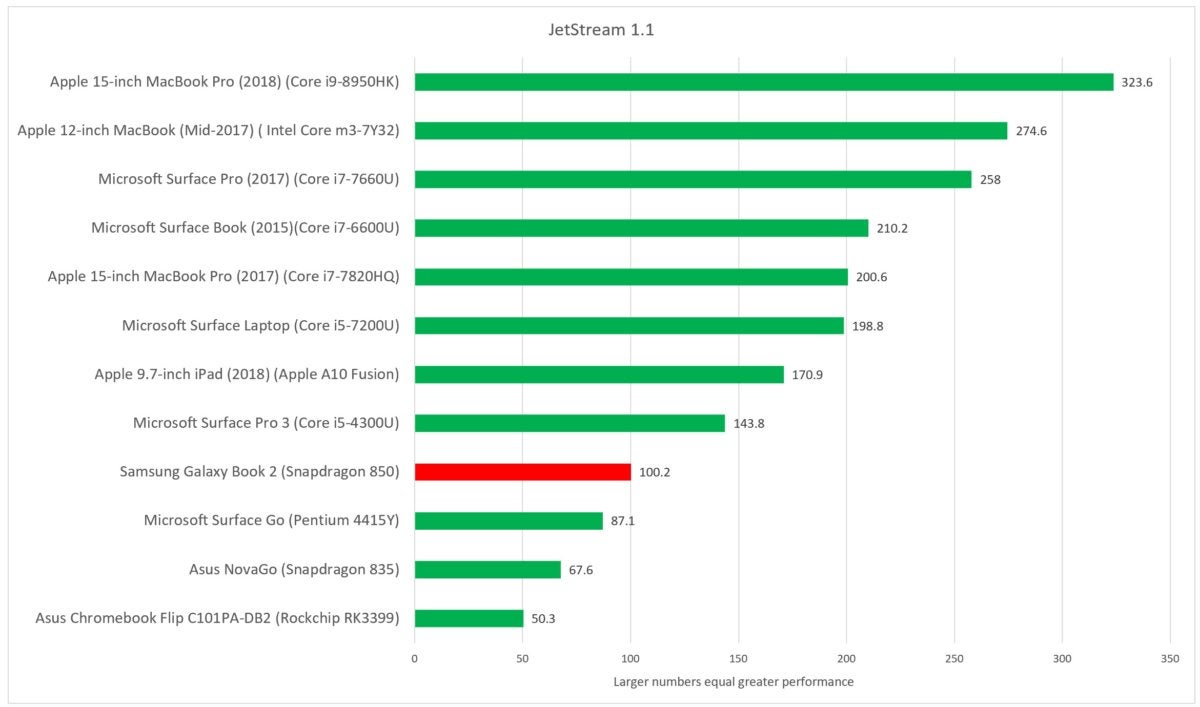
The Jetstream 1.1 benchmark runs a series of synthesized JavaScript tests, each designed to sequestrate a particular workload that would bear upon web operation. The Galaxy Book 2 unimpressively leads the rear guard.
 Tick off Hachman / IDG
 Here, the Samsung Beetleweed Book 2 starts showing the performance tradeoffs the Qualcomm Snapdragon 845 crisp made.
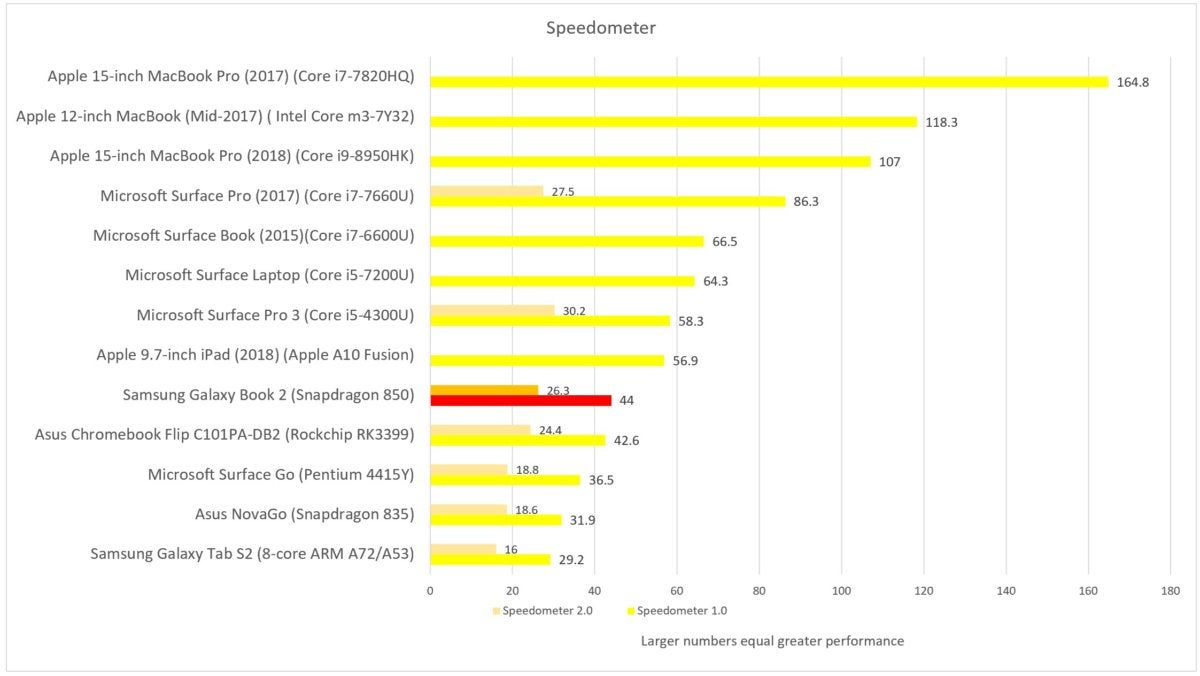
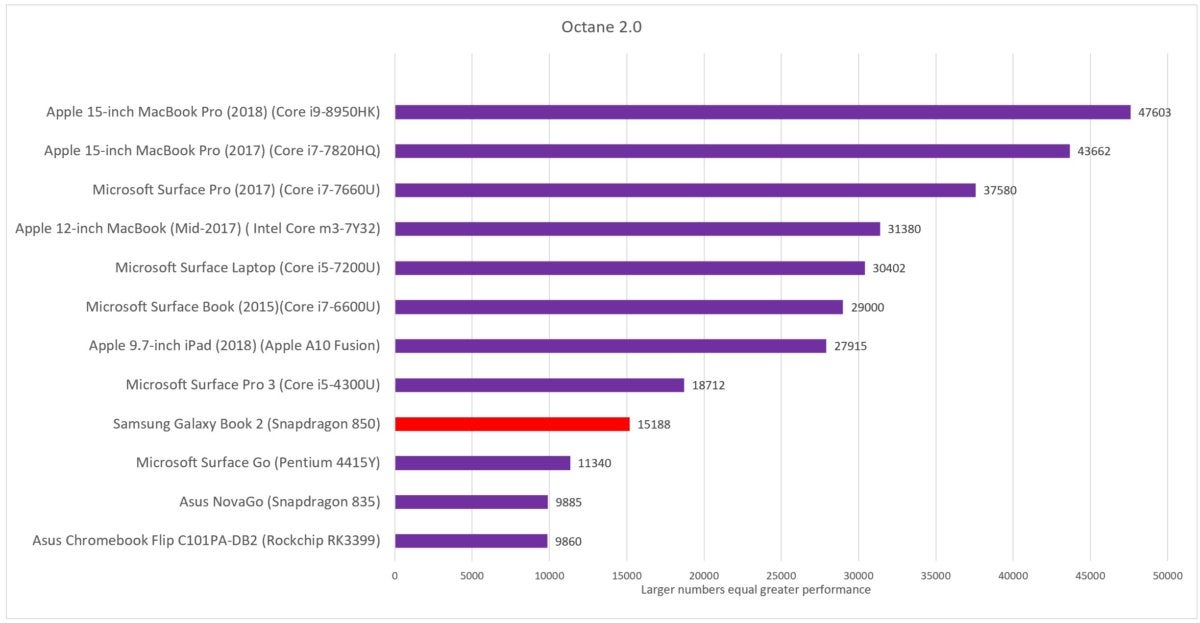
We've included both versions of the elderly Speed indicator benchmark, designed to measure the responsiveness of web applications. (In real-world browser habit, the Book 2 mat up as responsive arsenic a much more powerful laptop, peculiarly when victimization Microsoft Edge.) Google's deprecated Octane benchmark was also tested. In both cases, the Galaxy Scripture 2 lands at the spinning top of the bottom (or take down middle, if you're a glass-half-full sort of individual), A seems to be the general trend for it.
 Mark Hachman / IDG
  Mark Hachman
 You can control the trend: The Samsung Galaxy Al-Qur'an 2 finishes near, simply not at, the bottom of the pack. Here, though, it outperforms the Surface Go.
Samsung Beetleweed Book 2: PC benchmarks
As I noted in my review of the Microsoft Surface Go and Windows 10's October 2018 Update, Microsoft's Butt against browser now feels fast and responsive—and with the Galaxy Book 2, you need all the help you can get.
Thither's a literal difference in how the Galaxy Reserve 2 feels in terms of the web browser you use with it. I was able to ingenuous ten media-rich tabs in Edge, and the web browser mat up windy and answering, capable to navigate most pages within a second—evening lively back to older tabs. Occasionally, the images would take a minute longer to load, though, I was able to curl risen and inoperative the Sri Frederick Handley Page. Oddly, it was decelerate toclose the application.
Chromium-plate, meanwhile, felt much, a lot slower, and pages took rather a while to open entirely. That May have to make with how Chrome "sandboxes" each tab, and Chrome's reputation for gobbling memory won't help in a 4GB automobile wish the Galaxy Book 2. It's a markedly different experience.
While the Galaxy Book 2 is a trifle faster than the original Galaxy Book of account, it's generally passabl easy for intensive, computational process. Eastern Samoa we noted above, two tests—Cinebench and HandBrake—refused to execute. (While they did on an older Snapdragon-powered PC, the Asus NovaGo, that laptop also used a beta version of Windows 10 in S Mood.)
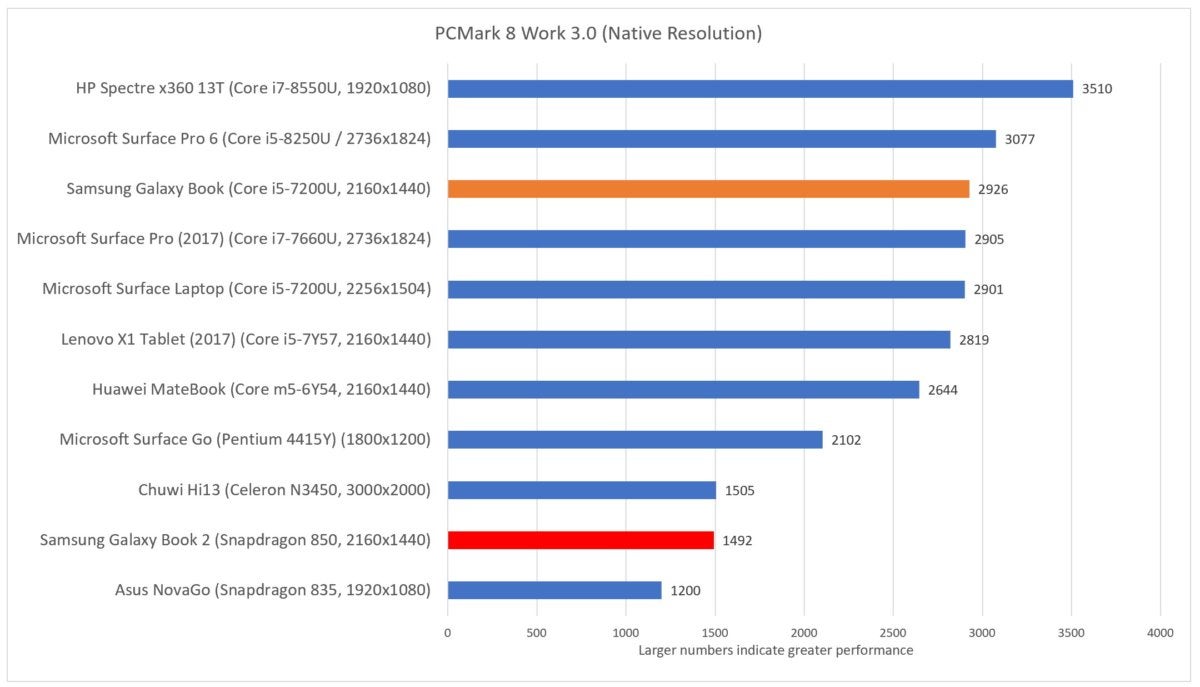
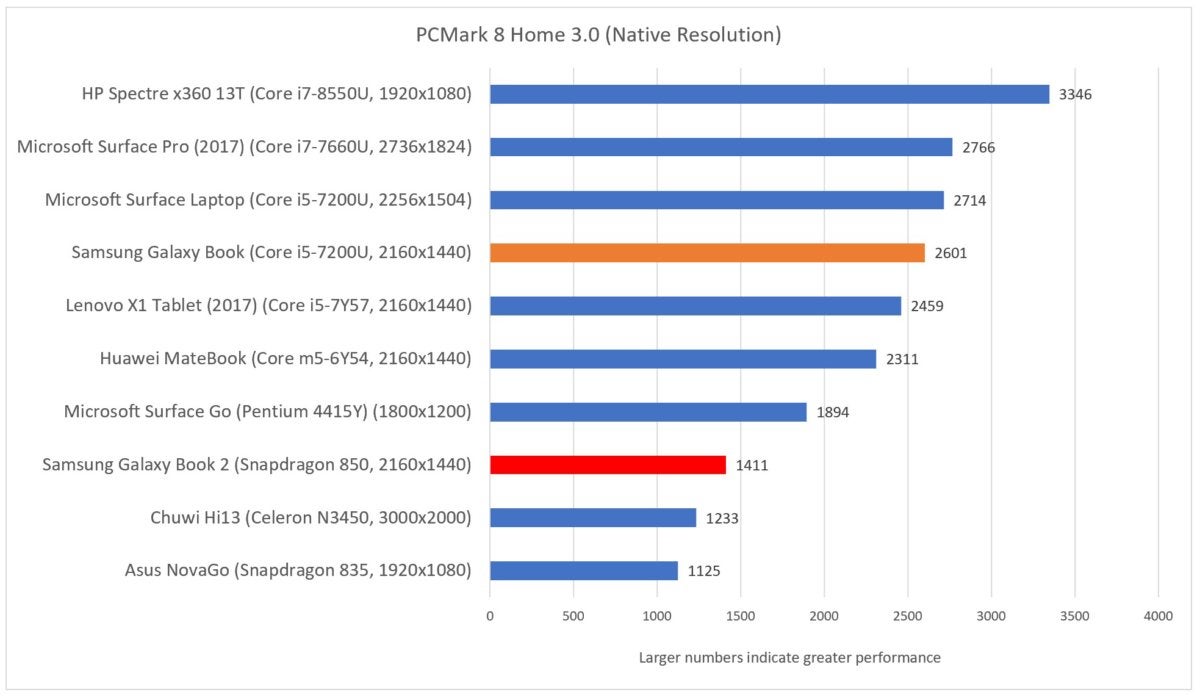
We've compared the Galaxy Book 2 (in red) to a numeral of tablets, including the first-generation Galaxy Scripture, which we've highlighted as well (in orange). The gulf between the Intel CORE i5 in the first coevals and the Qualcomm Snapdragon 850 in the second contemporaries is wide.
The PCMark Influence test measures spreadsheet carrying into action, Word processing, WWW browsing, and VOIP calls, which is pretty critical. The Home try out, which adds many light gambling and image handling, puts some additional stress on the Adreno GPU.
 Mark Hachman / IDG
  Mark Hachman / IDG
 As you can escort, Samsung took a huge cut in performance by moving from the Intel Core i5 to the Qualcomm Snapdragon 850. The Snapdragon 835 in the Asus NovaGo was the prior-coevals chip.
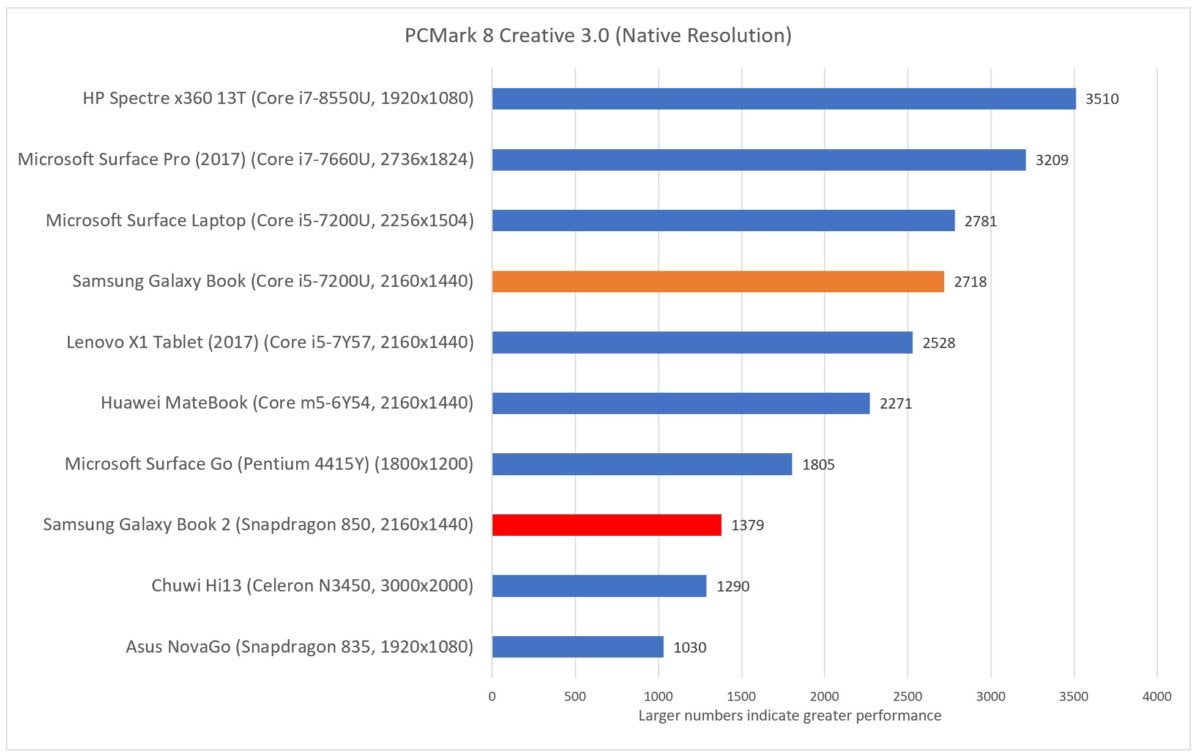
We besides proven the Book 2 with the PCMark Creative test, the most trying of the three in footing of overall performance. Information technology measures image manipulation and picture editing, light gaming, and VOIP calls. Again, the Ledger 2 tin't maintain with Intel Core-powered laptops and tablets.
 Sign Hachman / IDG
 From a carrying out standpoint, you'd probably prefer the senior Samsung Galaxy Book. Still, the Snapdragon 850 does substantially outperform the Asus NovaGo and its Snapdragon 835 chip.
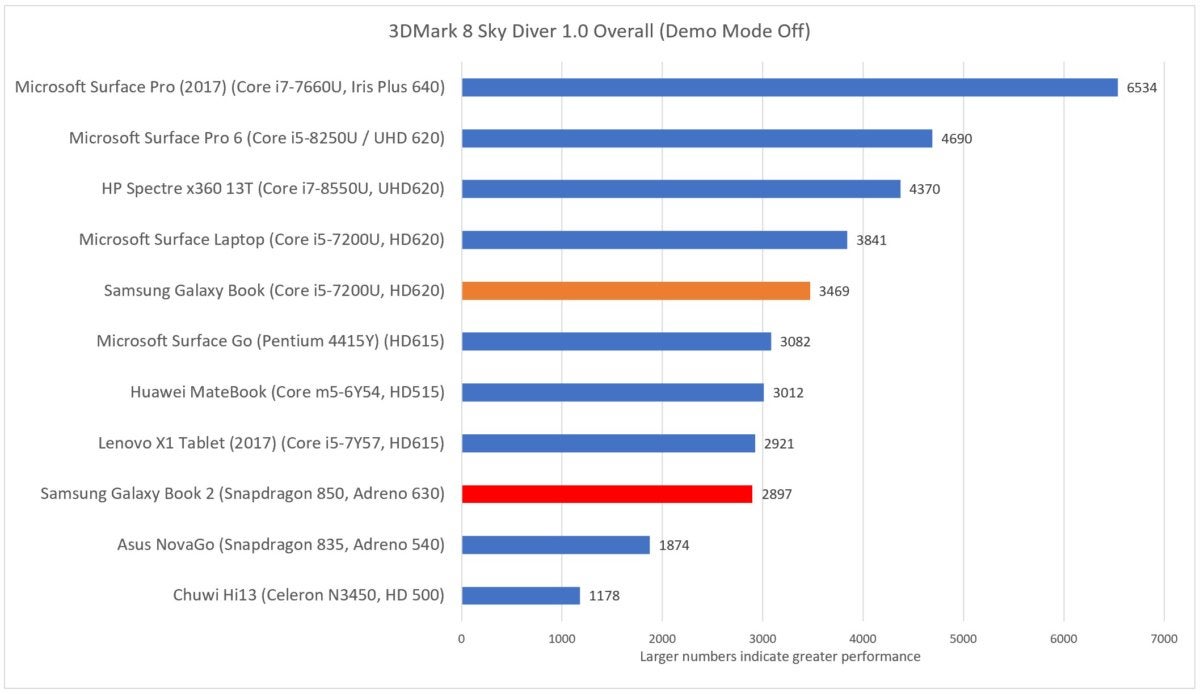
The 3DMark Flip Frogman tests assesses how well a laptop computer operating theatre chip would do in 3D gaming performance. These results should tell you that play simply isn't the Galaxy Reserve 2's accent. The Adreno GPU has zero problem with video decipherment, all the same, which ISN't calculated Here.
 Mark Hachman / IDG
 The well news here is that a keep down of tablets are identical, identical close to the Wandflower Book 2 in terms of GPU carrying out. Leave the Galaxy Book play a simple card-based game like Hearthstone? IT should. But block anything with complex 3D graphics.
Merely expect! Wefinally strike the piece de resistance of the Samsung Galaxy Book 2, and the Qualcomm Snapdragon chips: battery life. This is why you should equal interested in the Galaxy Book 2, and it's here that information technology will pay you backwards in spades. We use a exposure meter to establish a standardized level of light output for comfortable viewing, then loop a 4K pic (with headphones connected and volume at its middle setting) until the electric battery expires. The Samsung Galaxy Book 2 delivers, then some: 17 hours and 12 minutes of battery life history. That's almost in a league of its own.
 Home run Hachman / IDG
 Retesting the barrage life of the Samsung Galaxy Book 2—remember, these things bring on a patc!—confirmed that the shelling life is the best we've seen all the same: 18 hours and 21 minutes.
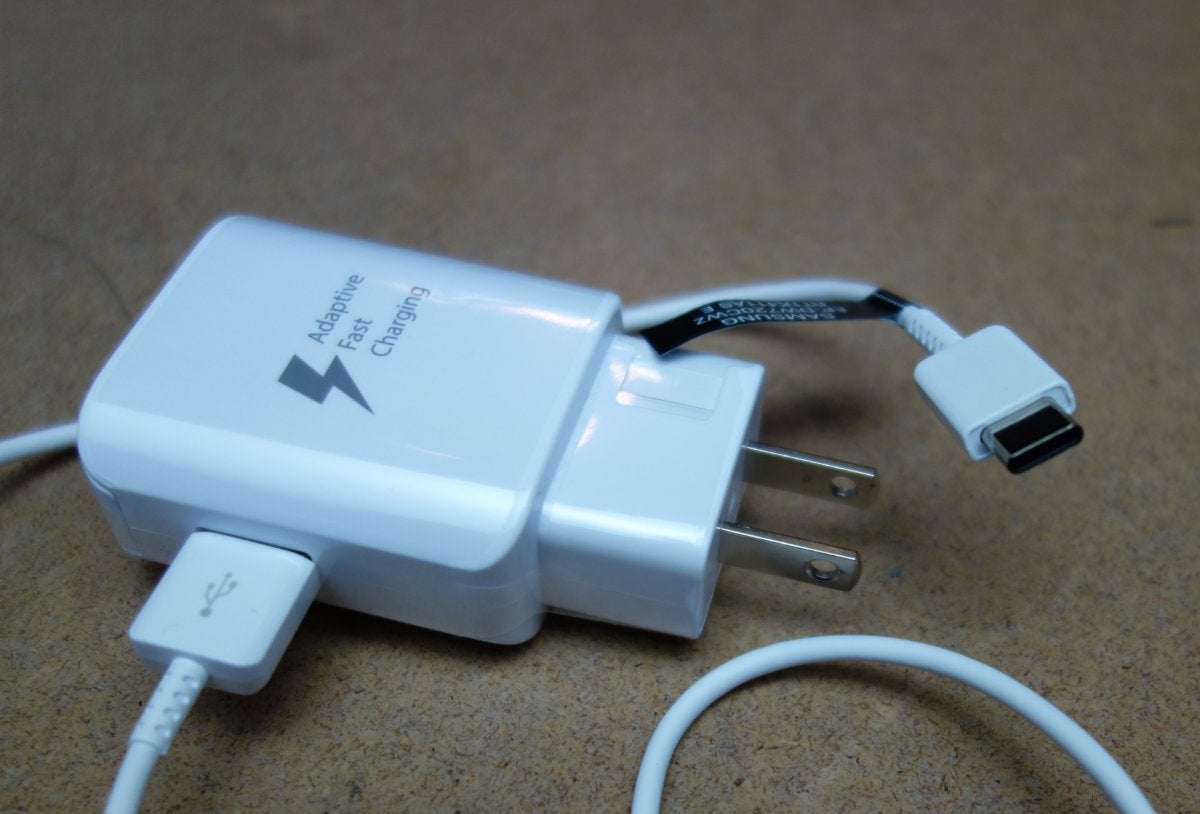
One thing wedon't like, though: Supposedly the Galax Book of account 2 ships with a "Fixed Charging" smartphone-style USB-C 1-amp charger. When Windows reports that IT leave require over 3 hours to load the laptop, we birth to wonder if Samsung should rethink the stigmatisation.
 Mark Hachman / IDG
 The Samsung Galaxy Book 2's charger should look familiar to smartphone owners.
Decision: Buy it for the assault and battery
The Samsung Beetleweed Reserve 2 delivers fantastic battery life, marginal performance, a endearing display, and facultative LTE. If you're not doing much more with it than business office work and web browsing, we see none reason not to buy up it. We still encounter any apps that simply won't keep going a Snapdragon chip, though, and we're hesitant to commend anything that may cede a similar get. Buying a notebook computer surgery tablet that prat't run the nonpareil app you need is a frustrating experience.
Though IT never rather crested our Editor's Choice awards, the master copy Galaxy Book was a solid all-round effort. Samsung's leaned heavily toward battery life this time around, at the expense of performance and slight app compatibility. Don't forget the toll, either—$999 isn't bad, which includes the keyboard and pen.
Performance issues left a sour taste in my mouth, as did the refusal to run a dyad of apps. Only I was reluctant to give back back the Beetleweed Book 2, simply because I prize a laptop that allows you to work on the co-occur with without worrying about running dead of juice. In short, our recommendation remains essentially the same As the Asus NovaGo: If you can go for the risks and a bit of frustration, and esteem battery life in a higher place complete else—so yes, the Galaxy Book 2 is emphatically the lozenge for you. If you're unsure, you may as well wait—faster Snapdragon chips are on the horizon.
Note: When you purchase something after clicking links in our articles, we may earn a small commission. Read our associate relate policy for more details.
Eastern Samoa PCWorld's old editor, Mark focuses on Microsoft news and chip technology, among other beatniks. He has formerly written for PCMag, BYTE, Slashdot, eWEEK, and ReadWrite.

Source: https://www.pcworld.com/article/402960/samsung-galaxy-book-2-tablet-hands-on-performance-takes-a-backseat-to-battery-life-2.html
Posted by: hamiltonsexpround.blogspot.com
0 Response to "Samsung Galaxy Book 2 tablet review: Performance takes a back seat to battery life - hamiltonsexpround"
Post a Comment